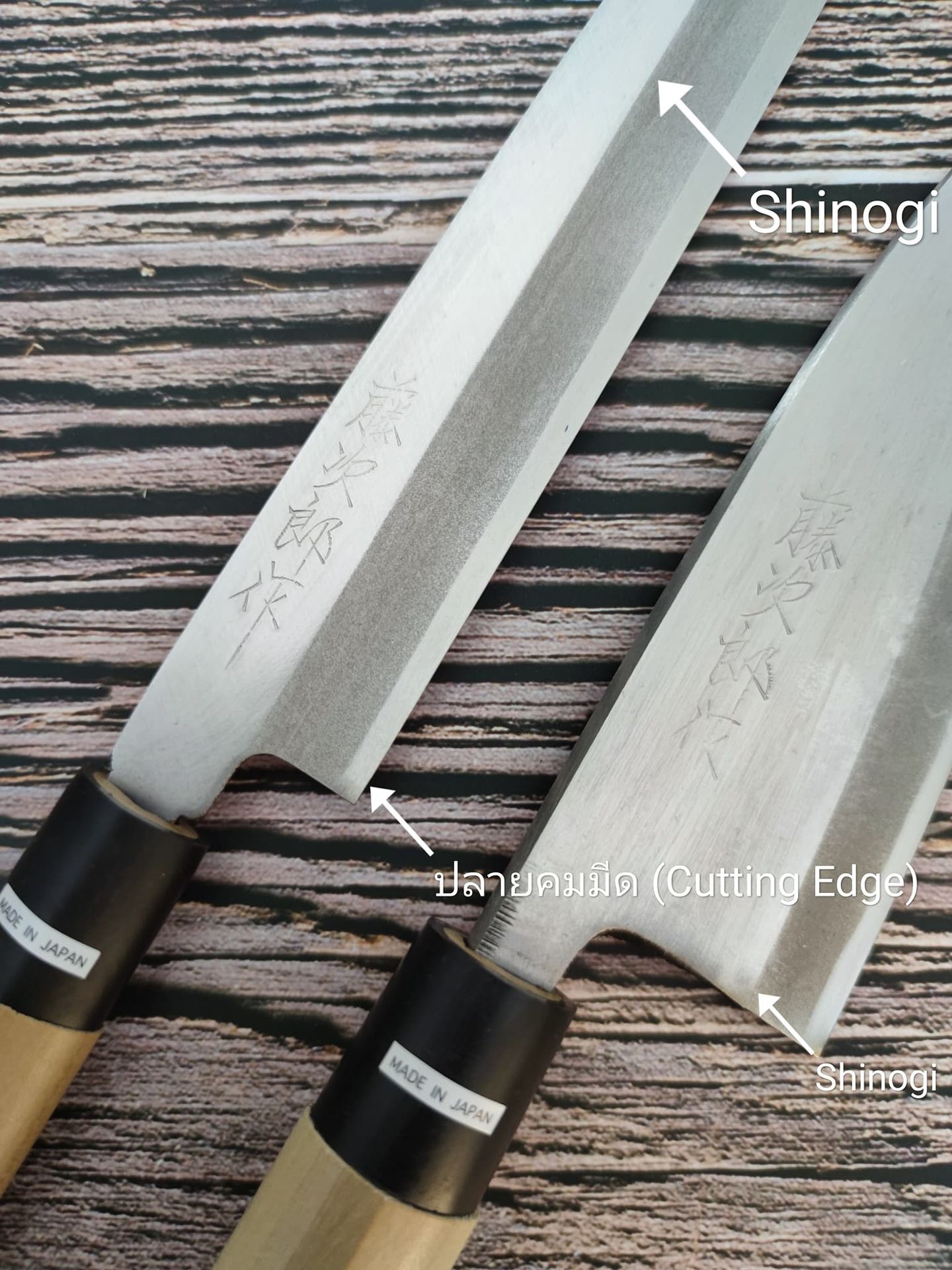
Many people assume that single-bevel Japanese knivessuch as the Deba (for breaking down fish) and the Yanagiba (the sushi knife) are hard to sharpen, simply because they are unfamiliar. In fact both types are very easy to sharpen — easier than the chef's knife, the Gyuto or the Santoku we use so often — because these knives have a slope on one side only, while the other side is flat. Look at the photograph I took of the sloped side. The key thing to notice is the shinogi line, marked by the white arrow in the picture, which slopes down to the cutting edge. When sharpening, besides the edge we want, this slope is the other thing whose shape we need to preserve. The method, then, is to lay the whole area from the shinogi line to the edge flat on the stone. Let me say it again: completely flat, pressed right down onto the stone. Do not worry about wearing the knife away, because that is exactly what we want — this sloped area should wear down together with the edge. Just as important, the cutting edge itself must also be touching the stone, or no edge will form. This point matters enormously. Some people think they have it pressed down, but it has to be so tight that a fly could not slip a leg between the stone and the knife. Only then is it right, and only then will an edge appear. That is the single most important secret of sharpening. For the finer points, I recommend studying the Tojiro and Naniwa videos below. They are extremely thorough — and Naniwa in particular has given us permission to translate their video into Thai.
|
Sharpening video from Naniwa |
Sharpening video from Tojiro — starts at 2:30 |